EU-Canada Partnership Needs More Than Words, Senior MEP Warns
Tobias Cremer, the European Parliament's rapporteur on Canada, stated that the EU's proposed 'associate membership' for Canada should be formalized within a concrete institutional framework.
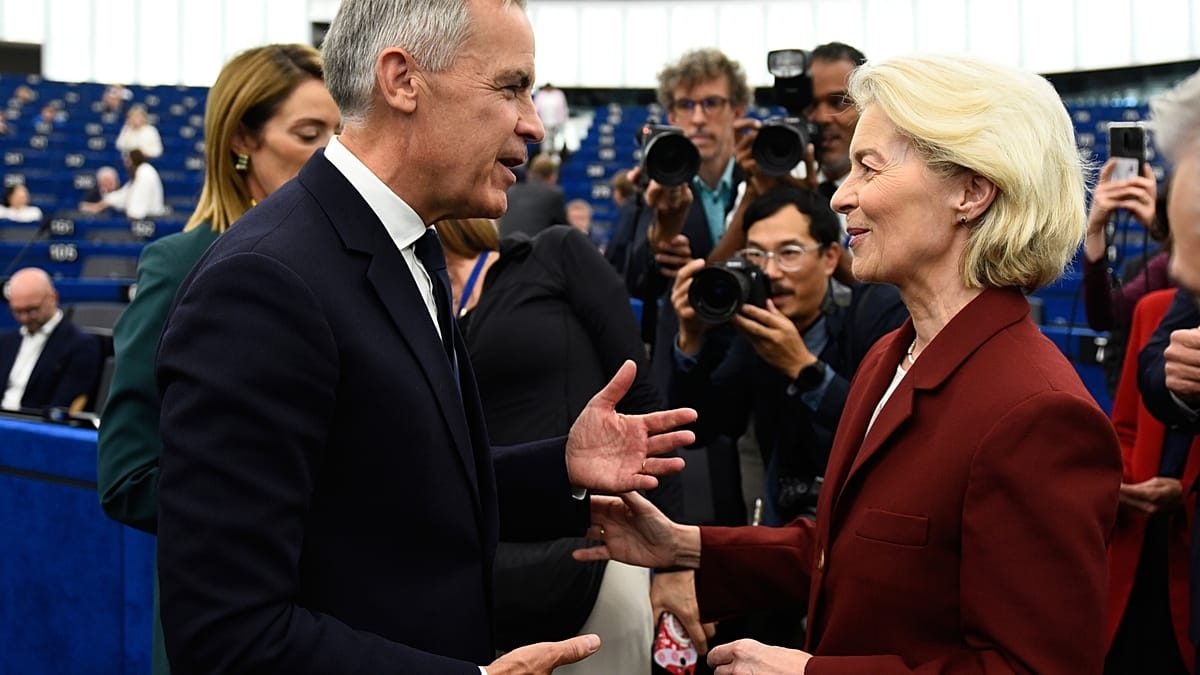
Tobias Cremer, the European Parliament's standing rapporteur on Canada, has emphasized that the European Union's (EU) offer of "associate membership" to Canada must evolve into a meaningful partnership that extends far beyond trade. Speaking to Euronews, Cremer underscored the importance of embedding this relationship within a concrete institutional framework.
European Commission President Ursula von der Leyen invited Canada to become the EU's first "associate member" in September, yet provided few details on what this unprecedented status would entail. Amidst geopolitical shifts drawing Brussels and Ottawa closer, the two sides are set to meet at a summit in Montreal next week, where agreements are anticipated in areas such as critical raw materials and digital cooperation.
Highlights
- Tobias Cremer argued that the EU's "associate membership" offer to Canada needs to move beyond mere rhetoric and be supported by concrete actions.
- He stated that associate membership should represent the "closest possible partnership" the EU can offer to a non-European country.
- Cremer advocated for the partnership to encompass sectoral agreements beyond trade, covering areas like defense, digital cooperation, and the Arctic.
- Suggestions included Canada participating "as an observer" in the Council of the EU and the creation of a formal parliamentary partnership assembly.
- Cremer also noted the potential for similar cooperation with the UK, though he believes their ambition should be full membership.
Details
Cremer, a German socialist MEP, remarked that for the past few months, Canada and Europe have been "great at writing each other love letters," but now is the time to "get serious and turn that love story into concrete commitments." He believes that associate membership must signify the "closest possible partnership that the EU can offer to a non-European country," and given that Canada is "probably the most European of non-European countries," this should be a very close bond.
He insisted that the relationship must amount to more than just "a trade deal 'plus'." Cremer called for a "pragmatic approach" involving sectoral agreements across trade, defense, digital cooperation, the Arctic, and student exchanges. Furthermore, he suggested that these initiatives should be embedded "into something more enduring, into a common institutional framework of coordination and cooperation."
His proposals include Canada participating "as an observer" in the Council of the EU, where national ministers meet, and the establishment of a formal parliamentary partnership assembly. Such a body could mirror the existing EU-UK Parliamentary Partnership Assembly, which convenes 35 members from each side twice a year to focus on specific policy areas.
Why it matters
These statements reflect the EU's efforts to redefine its relationships with allies in the face of geopolitical changes. A deeper institutional partnership with Canada could be part of the EU's strategy to enhance its global influence and strengthen cooperation with countries that share its values. This move could pave the way for new models of collaboration not only in trade but also in critical areas such as security and digitalization.