India's 'Cockroach Janata Party' Leaders Detained After Entering Barricaded Protest Site
Leaders of India's 'Cockroach Janata Party' (CJP) were detained after attempting to enter a restricted protest site in Delhi, demanding the resignation of the election chief over revised voter lists.
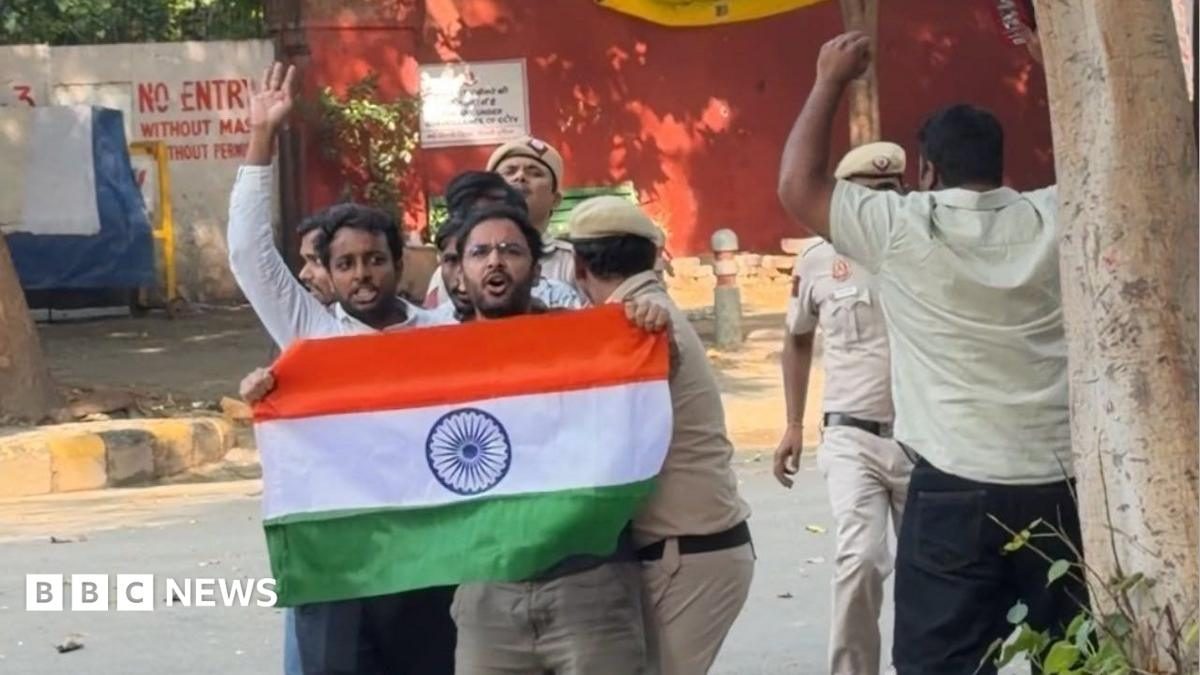
Leaders of India's opposition 'Cockroach Janata Party' (CJP) were detained on Tuesday morning in Delhi after attempting to enter Jantar Mantar, a heavily guarded protest site, to demand the resignation of election chief Gyanesh Kumar over a controversial revision of electoral rolls. Party founder Abhijeet Dipke shared a video showing Ashutosh Ranka and Saurav Das being taken away by police from the historic observatory, which is a popular protest venue. The detentions occurred a day after the federal home ministry announced that Jantar Mantar would no longer be a designated protest site.
Highlights
- CJP leaders Ashutosh Ranka and Saurav Das were detained for entering Jantar Mantar in Delhi without permission.
- Protesters are demanding the resignation of Chief Election Commissioner Gyanesh Kumar over a controversial revision of voter lists.
- Jantar Mantar has been de-notified as a protest site by the federal home ministry.
- Opponents of Prime Minister Narendra Modi allege the voter list revision benefits his party.
- Thousands of people, including journalists, were detained over the weekend amid heightened security.
Details
The footage showed the CJP leaders climbing over police barricades before chanting slogans while holding the Indian flag. Ashutosh Ranka later appeared on an Instagram live broadcast from a police bus, appearing cheerful and stating they would not back down. This incident follows the federal home ministry's decision to identify three alternative locations for demonstrations, requiring permission.
Opponents of Prime Minister Narendra Modi claim that the voter list changes benefit his party, a charge rejected by both the ruling party and the Election Commission. The main opposition Congress party has also petitioned the Supreme Court, challenging the Election Commission's voter revision exercise, which has reportedly led to the removal of tens of millions of names from electoral rolls.
Why it matters
These events highlight growing concerns in India regarding the transparency of the electoral process and the protection of democratic rights. The restriction of protest venues and the detention of opposition leaders indicate increasing pressure on the opposition by the government. The potential impact of the voter list revision on millions of voters further escalates political tensions in the country.