Neanderthal Wooden Tools Found Preserved in Stone in Spain Shed Light on Daily Life
In Spain's Abric Romaní rock shelter, wooden tools belonging to Neanderthals, dating back **62,000 to 40,000 years ago**, were found preserved within limestone crusts.
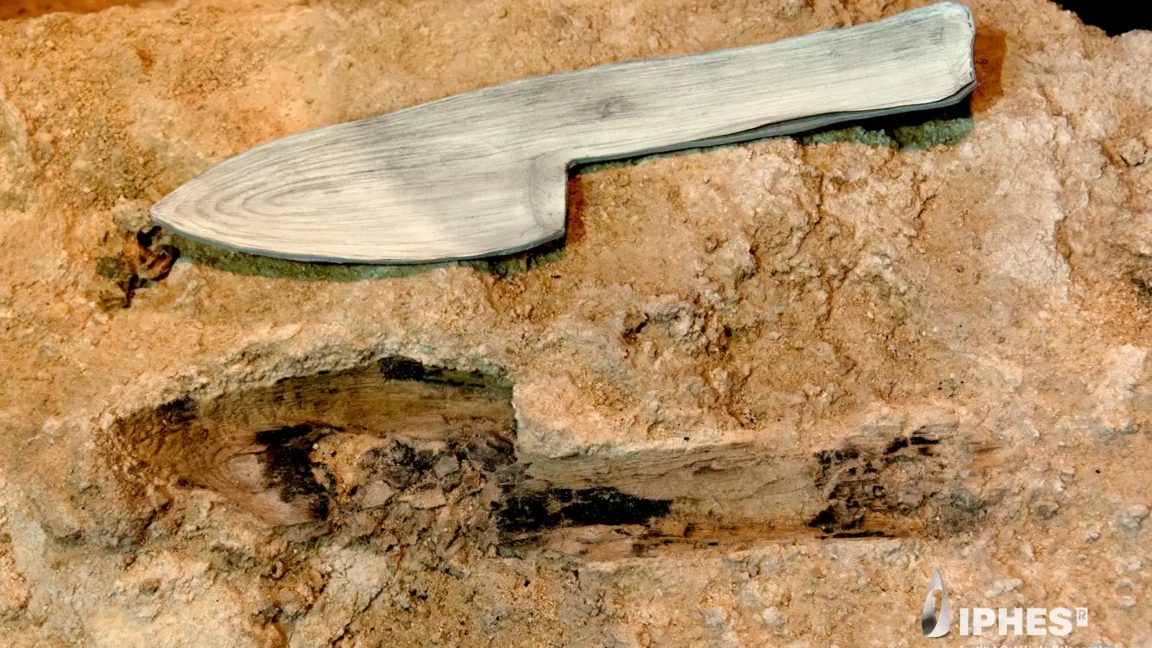
Remains of wooden tools used by Neanderthals in their daily lives have been discovered at the Abric Romaní rock shelter near Barcelona, Spain. These artifacts, dating from 62,000 to 40,000 years ago, were preserved within a limestone-like crust, with the decaying wood leaving behind hollow molds that perfectly reflect the original tools' shapes.
This rare discovery indicates that Neanderthals skillfully used wood not only for hunting but also for shelter, food preparation, and other daily activities. Researchers suggest these findings could alter our current understanding of Neanderthal cognitive abilities and social organization.
Highlights
- 597 Neanderthal wooden remains were cataloged at Abric Romaní in Spain, with 13 identified as tools made or modified by Neanderthals.
- The finds include spears, digging sticks, bark trays, parts of shelters, and a previously unseen club.
- The tools were preserved as mineral-rich water coated the wood in a limestone-like crust, leaving hollow molds after the wood decayed.
- This discovery shows that woodworking was a routine activity for Neanderthals, used for various subsistence activities beyond just hunting.
- The findings suggest Neanderthals possessed complex planning and cognitive abilities, challenging the perception of them as "Homo sapiens' dumber cousins."
Details
The team, led by archaeologist M. Gema Chacón from the Catalan Institute of Human Paleoecology and Social Evolution (IPHES-CERCA), made these significant discoveries at Abric Romaní, a site continuously excavated since 1983. To study these fragile, hollow remains, the team developed special methods, creating digital replicas of the tools using 3D scanning and photogrammetry. These 3D-printed copies are utilized for both scientific research and museum displays.
Among the 13 identified wooden tools, a well-preserved spear 2.45 meters long and a unique club with a 16-centimeter handle, unlike anything seen before, stand out. The club is thought to have been used for hunting or daily tasks. Additionally, shallow trays made of juniper bark, found near hearths, may have been used to carry food or scoop embers.
Evidence also suggests Neanderthals arranged small hearths along the back wall of the shelter and used a long pole as a windbreak or simple hut. These arrangements indicate that Neanderthals organized their living spaces in a planned manner and adapted to environmental conditions.
Why it matters
These findings support the growing evidence that Neanderthals were not merely primitive hunters but possessed complex thinking, planning, and diverse woodworking skills. According to M. Gema Chacón, Neanderthals' choice of wood demonstrates their knowledge of specific tree species for particular purposes, showing a mastery comparable to their stone tool craftsmanship. This discovery reshapes our perception of Neanderthal mental capacities and cultural complexity, positioning them as a species closer to Homo sapiens.