EU Commission President Von der Leyen Considers Canada as Bloc's First 'Associate Member'
European Commission President Ursula von der Leyen announced that the EU is exploring the possibility of Canada becoming its first 'associate member,' a new status that would need to be created from s
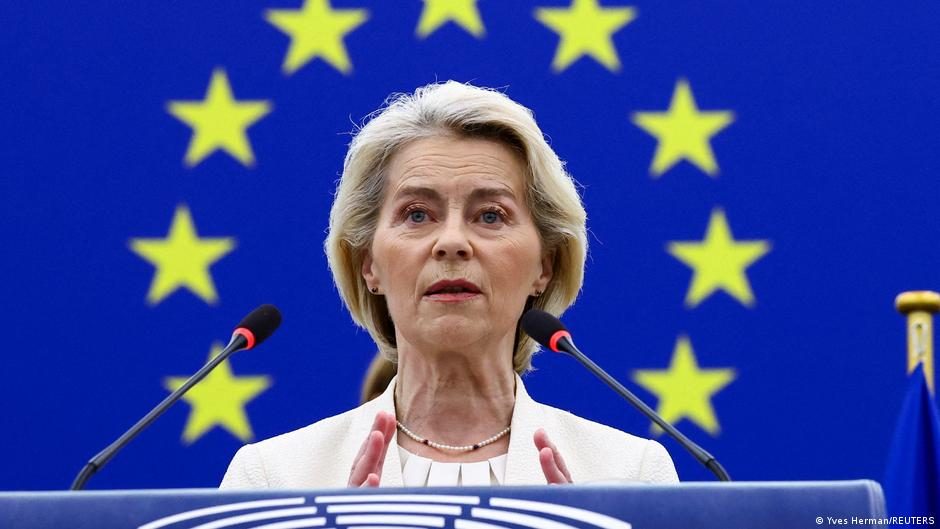
European Commission President Ursula von der Leyen, in her annual State of the Union address, revealed that the European Union is considering Canada as a potential first 'associate member.' This new status would require the EU to create a new framework from scratch. Von der Leyen emphasized that the EU and Canada share a common vision on various issues, from artificial intelligence to climate change.
Highlights
- Ursula von der Leyen stated the EU is eyeing Canada as its first 'associate member,' a new status to be created.
- She described the EU as facing an "openly hostile world" in her speech.
- Canadian Prime Minister Mark Carney had previously sought a "unique alliance" with the bloc.
- Von der Leyen called for increased European independence in energy and critical raw materials.
- She proposed sweeping restrictions on children's access to social media platforms.
Details
Von der Leyen's remarks were made during her annual speech at the European Parliament in Strasbourg, France, with Canadian Prime Minister Mark Carney in attendance. This development follows reports by the Wall Street Journal that Carney was exploring an "associate membership" with the bloc, a position that currently does not exist. Carney had previously clarified that he sought a "unique alliance" rather than full membership.
Both the EU and Canada expressed that they see eye-to-eye on issues like the war in Ukraine, defense, raw materials, and supply chains, and share a belief in democracy. They are looking to diversify their dependencies from China and the United States, respectively, through such partnerships. Von der Leyen highlighted that the EU remains 80% dependent on China for many critical raw materials and announced plans to establish a new European corporation for critical raw materials to build up reserves.
She also noted that the trade deficit with China has reached one billion euros a day, indicating that the "second China shock" is already underway. Von der Leyen stressed that managing climate change and artificial intelligence is crucial for the bloc's future prosperity and security. She promised a new "heatwave plan" following Europe's deadly summer and a push for the EU to lead in AI development. Additionally, she proposed social media restrictions, including barring children under 13 from accessing such services and allowing those aged 13 to 15 to use restricted "mini accounts" supervised by a parent or guardian.
Why it matters
These statements underscore the EU's strategic efforts to forge new partnerships and bolster its independence amidst a volatile international landscape. A potential 'associate membership' for Canada could establish a novel model for the EU's external relations, while initiatives to reduce raw material dependency and protect children on digital platforms highlight critical future economic and social policy directions for the bloc.