German President Steinmeier Laments 'Bitter Setbacks' on Unity Day
German President Frank-Walter Steinmeier, in his final Unity Day speech, warned that the hopes of the reunification era have suffered 'bitter setbacks' and that democracy is being challenged anew.
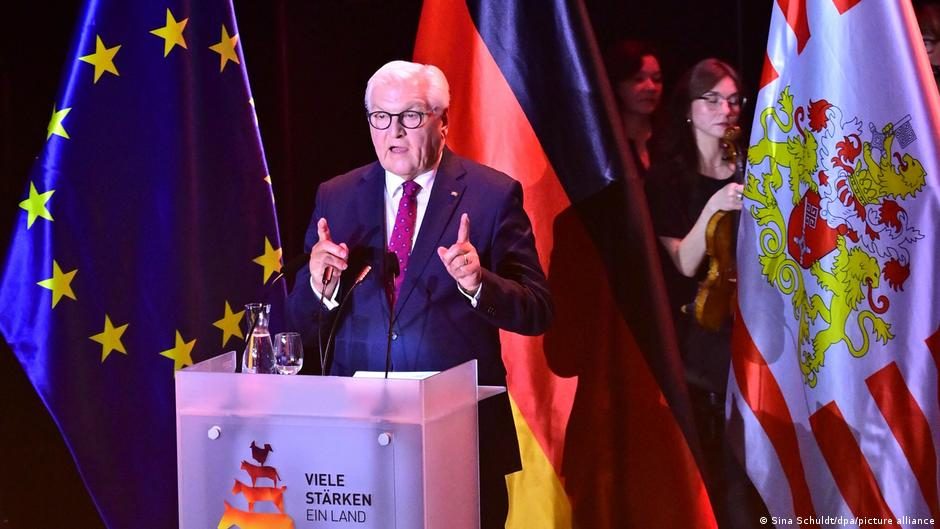
German President Frank-Walter Steinmeier used his last German Unity Day speech to express that the hopes following the country's reunification have experienced "bitter setbacks." Speaking at the official ceremony in Bremen, Steinmeier warned that democracy is being challenged again and that right-wing extremism seeks to erase the memory of Holocaust victims.
Germany is celebrating the 36th anniversary of its reunification, which occurred on October 3, 1990, when the five states of former East Germany joined the Federal Republic of Germany. Main events are being held in Bremen this year.
Highlights
- President Steinmeier stated that expectations for liberal democracy and international cooperation post-reunification have not been fully met.
- He highlighted threats to democracy, pointing to efforts by right-wing extremists to erase the memory of Holocaust victims.
- Steinmeier's second and final term ends in March 2027; his successor is expected to be elected in January 2027.
- Elisabeth Kaiser, Commissioner for Eastern Germany, called for the next president to come from East Germany.
- More than three decades after reunification, significant disparities in income, wealth, and representation in senior positions still persist between East and West Germany.
Details
During his speech at the German Unity Day celebrations in Bremen, President Frank-Walter Steinmeier reflected that his expectations following the changes that began in 1989 were greater than what ultimately materialized. "I thought everyone had learned the lesson from history, and now I see supporters of right-wing extremism seeking to erase the memory of the victims of the Holocaust," Steinmeier stated, adding that democracy is being challenged anew. Steinmeier, whose term concludes in March 2027, emphasized that the presidency is "not an office to be taken lightly" and that fostering social cohesion will become more demanding in the coming years.
The celebrations commenced with an ecumenical service attended by Steinmeier, Chancellor Friedrich Merz, and other senior officials. Over 550 events are scheduled in Bremen through Sunday, with more than 400,000 people expected to attend the public festival. The celebrations rotate among Germany's 16 states, with Bremen hosting this year as it currently holds the presidency of the Bundesrat (the upper house of parliament).
Elisabeth Kaiser, the German government's Commissioner for Eastern Germany, advocated for the next president to be from East Germany. Kaiser argued that Eastern Germans remain underrepresented in positions of power, stating, "That can quickly create the impression that eastern Germans play no role in leading our country and are only sitting at the children's table." She noted that Joachim Gauck (2012-2017) is the only president from East Germany since reunification.
Why it matters
President Steinmeier's warnings highlight the challenges Germany faces post-reunification, particularly the fragility of democracy amid the rise of right-wing extremism. The continued disparities between East and West Germany and the lack of political representation for Eastern Germans indicate significant hurdles remain in achieving the country's full unity. This situation is crucial for Germany's future political and social cohesion.