Britpop Meets Science: The Beagle 2 Mars Mission Celebrated
The legacy of Colin Pillinger, the scientist behind the UK's first spacecraft to reach Mars, Beagle 2, is being honored with plaques across the country.
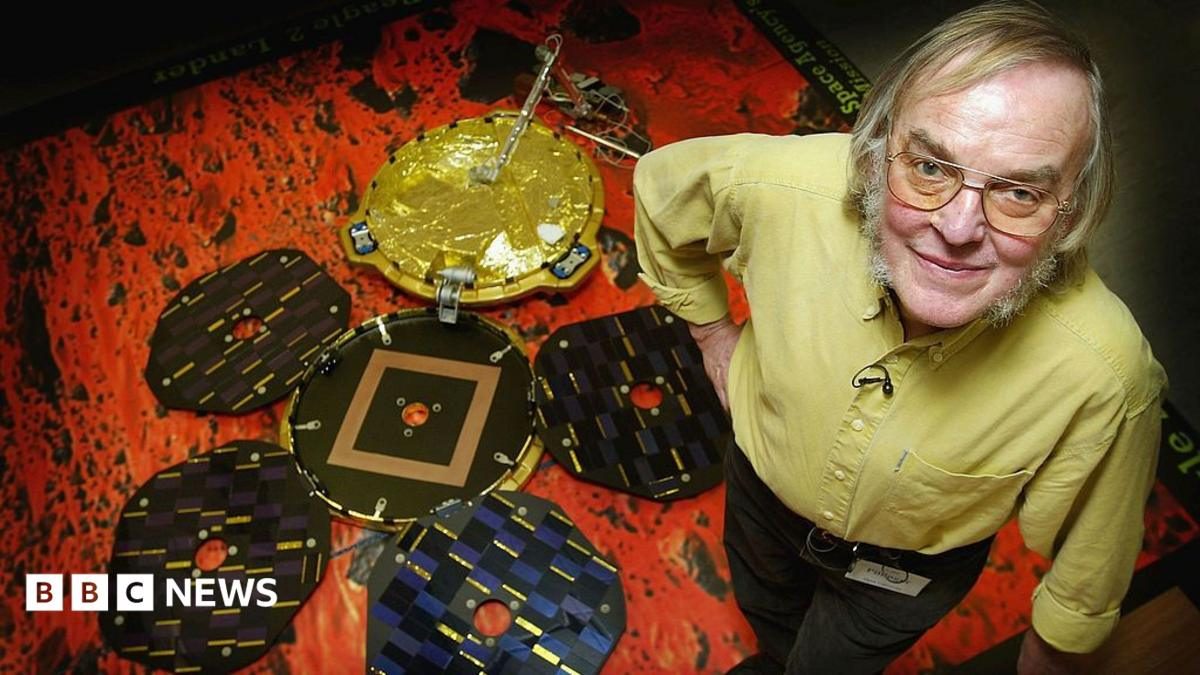
The story of Beagle 2, the UK's first spacecraft to reach Mars, is being celebrated with a series of plaques unveiled across the country. At the heart of this project was Professor Colin Pillinger, a maverick scientist known for his distinctive personality. Pillinger successfully convinced politicians, pop stars, and the public to support what seemed an impossible endeavor: a British mission to Mars.
For many years, Beagle 2 was synonymous with ambitious British failure. However, a surprising discovery made after Pillinger's death changed its narrative. High-resolution images captured by NASA revealed that Beagle 2 had indeed landed on the Martian surface but failed to communicate due to its solar panels not fully deploying.
Highlights
- Beagle 2, the UK's first spacecraft to reach Mars, is being celebrated with memorial plaques across the country.
- Professor Colin Pillinger, the mission's mastermind, passed away in 2014 believing the mission had failed.
- NASA images in 2014 confirmed Beagle 2 had landed on Mars, largely intact, just 5km from its target site.
- The lander's petal-like solar panels failed to open completely, trapping the antenna and preventing communication with Earth.
- Pillinger famously persuaded Britpop band Blur to compose a call-sign and artist Damien Hirst to create a calibration target for the mission.
Details
Colin Pillinger conceived the idea of sending Beagle 2, a lander named by his wife, to Mars to directly study the red planet for signs of life. This idea was developed at The Open University's Planetary and Space Sciences Research Institute. As Britain lacked a dedicated space agency, Pillinger proposed that Beagle 2 hitch a ride aboard the European Space Agency's (ESA) Mars Express spacecraft. This proposal was approved in 1999, though ESA did not guarantee funding or broader support.
Pillinger aimed to capture the public's imagination to attract financial backing. He employed creative methods, such as wheeling a replica of Beagle 2 in a supermarket trolley to demonstrate its compact size. The project eventually secured financial support from the UK government, academic institutions, industrial contractors, and private sponsors. Beagle 2 was reportedly built for about £50 million, a fraction of the $25 billion NASA spent on the Apollo program.
Beagle 2 launched on June 2, 2003, with Mars Express and was scheduled to land on Christmas Day. However, no communication was received after its expected landing. Pillinger and his team believed it had descended too quickly due to Martian atmospheric conditions. Official inquiries by the government and ESA criticized the project's finances and management. Undeterred, Pillinger proposed a successor, Beagle 3, which ESA rejected in 2004.
Why it matters
The story of Beagle 2 highlights the perseverance, ingenuity, and unexpected successes in scientific exploration. Colin Pillinger's vision and ability to rally public support demonstrated that a smaller nation could undertake a significant mission in a field dominated by major space agencies. The discovery of the lander years later, revealing a success Pillinger never knew in his lifetime, underscores the importance of hope and tenacity in the scientific community.