NASA's Roman Telescope Has Enough Fuel for 22 Years, Doubling Expectations
NASA's Nancy Grace Roman Space Telescope will have enough fuel for at least 22 years of operations, double initial expectations, thanks to its precise trajectory into orbit.
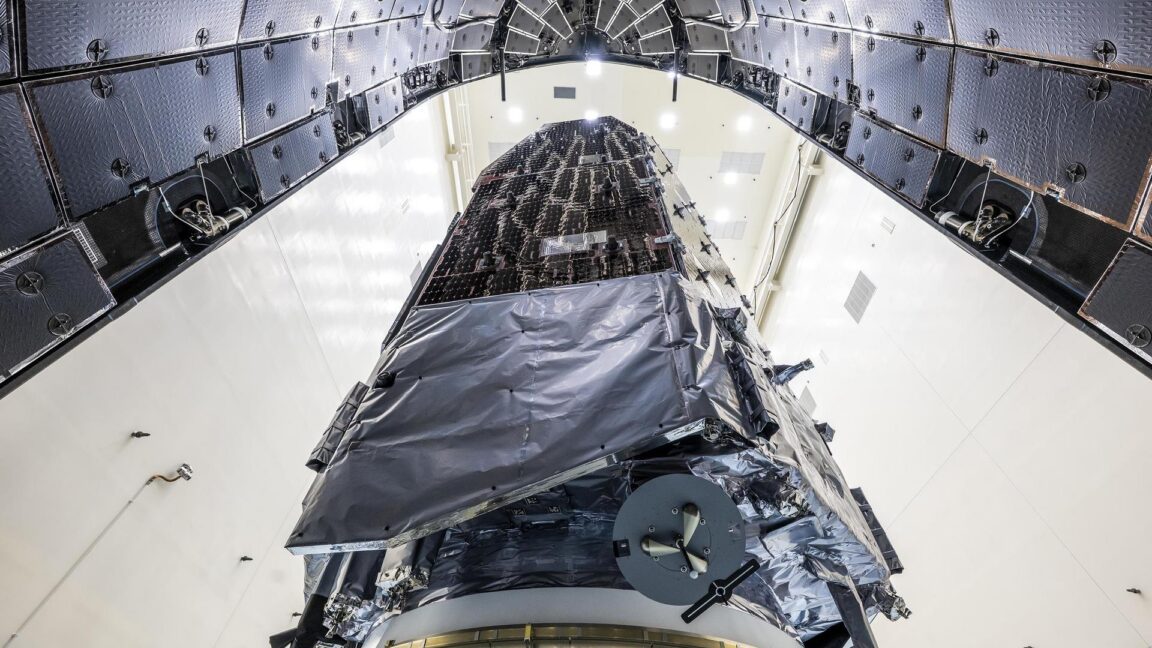
NASA's $4.3 billion Nancy Grace Roman Space Telescope, launched recently, achieved such a precise trajectory that engineers now estimate its fuel will last for at least 22 years, more than twice the initial expectations. This significant extension provides a substantial advantage for the telescope's mission to explore the universe.
Highlights
- The Roman Telescope is projected to have enough fuel for 22 years of scientific operations, more than double NASA's initial estimates.
- A precise launch by the SpaceX Falcon Heavy rocket and excellent execution by the operations team were key to the fuel savings.
- The telescope will observe the universe with the same resolution as the Hubble Space Telescope but with a 100 times wider field of view.
- Roman aims to map the largest structures in the universe to gain insights into dark energy.
- It is the first NASA observatory designed for potential in-space refueling missions in the future.
Details
The Roman Telescope was launched on August 30 from NASA's Kennedy Space Center in Florida aboard a SpaceX Falcon Heavy rocket. Initially, it was planned to carry enough propellant for a minimum five-year mission with a potential five-year extension. However, the flawless launch and the perfect execution of the first post-launch course correction maneuver meant Roman's control thrusters consumed far less fuel than anticipated. Jamie Dunn, center director at NASA's Goddard Space Flight Center, stated, "As a result of exquisite planning by our orbital dynamics team, brilliant execution by the operations team, and a precise launch from SpaceX, Roman has fuel for at least 22 years of potential science operations."
Roman will orbit a "quasi-halo" around the Sun-Earth L2 Lagrange point, located one million miles from Earth. This point represents a balance between the gravitational pulls of Earth and the Sun. The telescope's Wide Field Instrument, equipped with 18 near-infrared detectors, will produce images equivalent to a 300-megapixel camera. This broad viewing area will allow astronomers to map galactic clusters and the filaments of matter and dark matter threading through the cosmos.
Why it matters
The Roman Telescope's significantly extended mission life offers an unparalleled opportunity to deepen our understanding of the universe's large-scale structures, dark energy, and exoplanets. Its wide field of view and high resolution will enable a more detailed study of the universe's history and evolution than ever before. Furthermore, it sets an important precedent for the development and implementation of in-space refueling technologies for future space missions.