Saudi Arabia Seeks Alternative Oil Routes Amid Export Disruptions
Saudi Arabia is exploring alternative routes, including dark shipments and ship-to-ship transfers off Oman, to maintain crude oil exports following pipeline attacks and regional tensions.
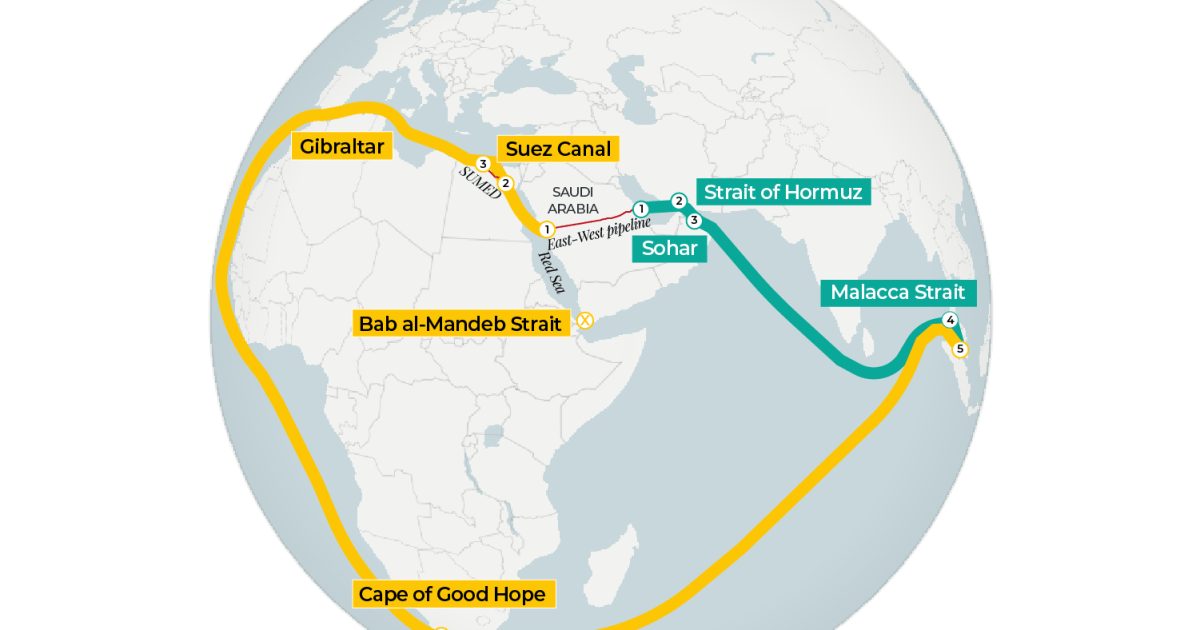
Saudi Arabia is facing significant disruptions to its oil exports after drone attacks on its East-West pipeline last week. The country is now resorting to alternative methods, such as ship-to-ship transfers off Oman and "dark" shipments with AIS (Automatic Identification System) transponders switched off, to ensure the continued flow of oil to global markets.
The attacks halted the flow of 4-5 million barrels per day (bpd) of oil, causing a substantial drop in global supply. Repairs to the pipeline are estimated to take three to five weeks, prompting Saudi Arabia to re-evaluate its export strategies.
Highlights
- Attacks on the East-West pipeline disrupted 4-5 million bpd of oil flow.
- Saudi Arabia is utilizing ship-to-ship transfers and "dark" shipments off Oman.
- Security concerns in the Strait of Hormuz and Bab al-Mandeb necessitate alternative routes.
- Daily crude loadings dropped to 2.3 million bpd in August and approximately 2.1 million bpd in early September.
- Experts anticipate a 1.5-2 million bpd reduction in exports even with a partial pipeline restart.
Details
The 1,200 km East-West pipeline, connecting Saudi Arabia's main oil-producing fields in the east to Yanbu port on the Red Sea coast, was crucial for bypassing the Strait of Hormuz. With this pipeline offline and the Bab al-Mandeb Strait controlled by Houthi forces, the country's export options are severely limited. Total Saudi crude loadings, which previously exceeded 7.5 million bpd, fell to around 2.3 million bpd in August and approximately 2.1 million bpd in the first half of September.
According to Rishi Rajanala, a research specialist at LSEG Data & Analytics, Saudi Arabia's options are constrained. "The first is shipping more crude from its Gulf terminals through the Strait of Hormuz, including ship-to-ship transfers outside the strait, such as off Sohar in Oman." These methods depend on factors like tanker availability, insurance, and freight costs, and remain well below pre-war levels. A second option involves drawing on crude already stored on the west coast and at Egypt’s Ain Sokhna and Sidi Kerir terminals, but this is only viable as long as stored volumes last.
Why it matters
As the world's second-largest oil producer, Saudi Arabia's ability to maintain crude flow is critical for global energy markets. The disruptions are increasing freight costs and exerting upward pressure on global oil prices. Brent crude, which had been trading at $70-$90 a barrel in recent months, has now surpassed $105 a barrel due to prolonged regional disruptions. This situation poses significant risks to energy security and global economic stability.