Blue Origin Aims for Lower Costs and Higher Performance with New Rocket Engine
Blue Origin is developing a new engine and third stage for its New Glenn rocket, aiming to reduce manufacturing costs and significantly increase payload capacity for ambitious space launch goals.
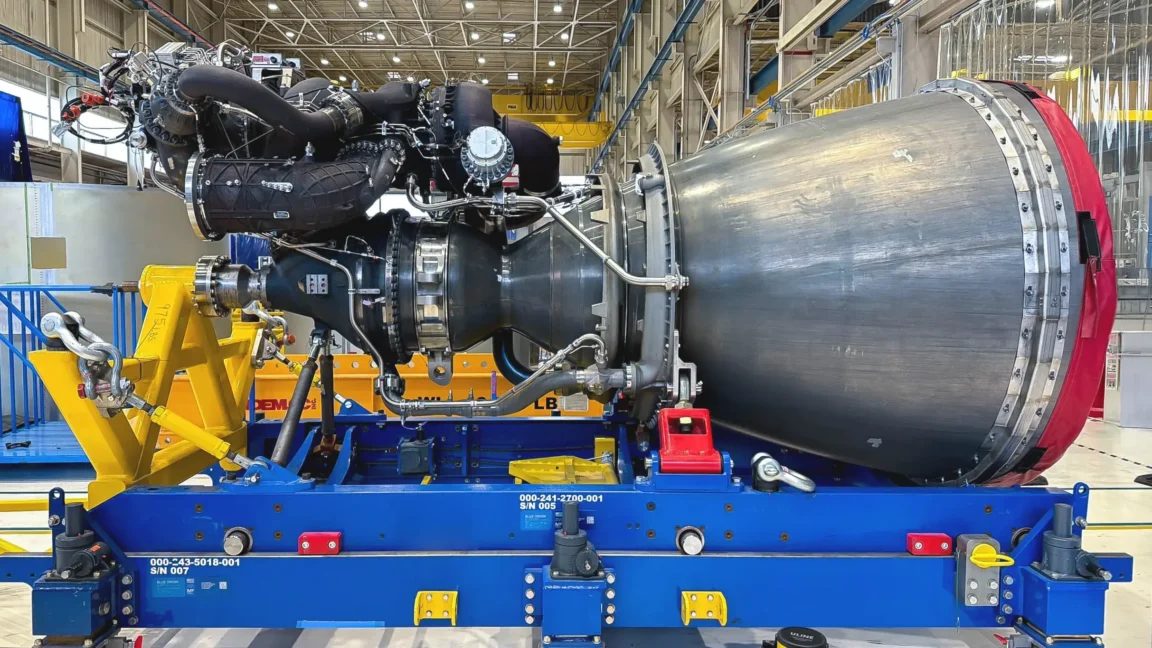
Blue Origin has announced two significant upgrades to its New Glenn rocket, designed to substantially lower manufacturing costs and expand its payload delivery capacity to geostationary orbit and the Moon. The company aims for these enhancements to eventually enable New Glenn to launch over 1,000 times a year. Dave Limp, CEO of Blue Origin, stated, "There has never been higher demand for launch, ever."
Highlights
- Blue Origin has begun test firing Northstar, a new engine set to power the first stage of the New Glenn rocket.
- The Northstar engine is projected to be manufactured at one-quarter the cost of the current BE-4 engine while offering increased thrust.
- The company is also developing GS3, a hydrogen-oxygen fueled third stage made from composite materials, to boost the rocket's capabilities.
- With these upgrades, New Glenn is expected to carry up to 8 metric tons directly to geostationary orbit and 10 metric tons to translunar injection.
- Blue Origin plans for the debut launch of a GS3-equipped New Glenn for a government customer in 2028.
Details
Blue Origin is working on Northstar, a new engine intended to replace the BE-4 engine currently used in the first stage of the New Glenn rocket. Northstar features a simplified design but boasts a starting thrust of 715,000 pounds, surpassing the BE-4's 640,000 pounds. The new engine has half the number of parts, 30 percent less mass, and approximately 65 percent can be 3D-printed. The company aims to produce Northstar at 25 percent of the BE-4's cost and assemble each engine in less than a day.
Additionally, Blue Origin is developing a hydrogen-oxygen fueled third stage for New Glenn, named GS3 (Glenn Stage 3). This stage will enhance the rocket's ability to directly inject payloads into geostationary orbit and Earth-escape trajectories. To keep it lightweight, GS3 is largely constructed from composite materials. Blue Origin recently announced a breakthrough in testing 5.5-meter composite liquid hydrogen tanks, demonstrating their ability to withstand 150 percent of the maximum expected operational pressure for 10 minutes.
Why it matters
These advancements represent a significant step towards reducing the cost of space access and increasing launch capacity. Blue Origin's ambitious goals could intensify competition in the commercial space launch market, potentially paving the way for more frequent and affordable space missions in the future. The increased payload capacity, particularly for lunar and beyond missions, holds the potential to unlock new opportunities for space exploration and commercial ventures.