James Webb Telescope Discovers Ice Older Than Its Star in Beta Pictoris System
The James Webb Space Telescope has found amorphous water and carbon dioxide ice in the disk around the Beta Pictoris star, believed to be older than the star itself.
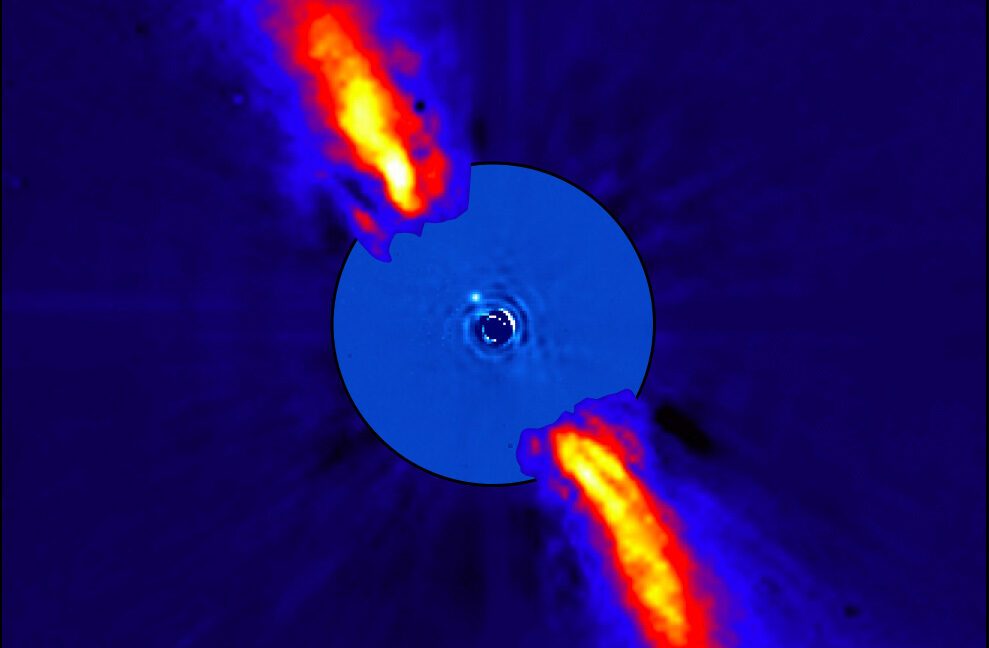
A new study using the James Webb Space Telescope (JWST) has revealed the presence of ice in the debris disk surrounding the young star Beta Pictoris, with evidence suggesting this ice is older than the star itself. The detected ice is a mixture of water and carbon dioxide, mirroring the composition found in comets within our own Solar System.
Scientists propose that these ices originated in the interstellar medium before the star system formed, implying that the fundamental building blocks necessary for planet formation might be common throughout the universe.
Highlights
- Amorphous Ice Structure: The discovered water ice is amorphous (glass-like) rather than crystalline, indicating it froze rapidly at extremely low temperatures, consistent with formation in the interstellar medium.
- Carbon Dioxide Mixture: Carbon dioxide is found mixed within the water ice. This combined structure is believed to enhance the ice's resilience against the star's ultraviolet radiation.
- Cometary Similarities: The proportion of carbon dioxide in the ice is similar to that observed in comets in our Solar System and in the ice disks around other newborn stars.
- Constant Replenishment: The uniform distribution of ice across the disk suggests that frequent collisions among planetesimals (small planetary building blocks) continuously replenish the ice that is destroyed by starlight.
Details
A team led by astronomer Sarah Betti from the Space Telescope Science Institute in Baltimore observed Beta Pictoris using the James Webb Space Telescope's Near Infrared Spectrograph (NIRSpec). The observations confirmed the presence of water and carbon dioxide ices in the disk around this 20-million-year-old star, located 64 light-years away, which previous searches had failed to detect.
Analysis of the ice revealed that carbon dioxide molecules are trapped within the water ice. This 'dirty ice' structure aligns with theoretical models predicting its survival against the star's ultraviolet light. The team calculated that carbon dioxide constitutes approximately 11 percent of the ice.
The amorphous nature of the water ice suggests very cold and rapid freezing conditions. Researchers concluded that the ice most likely formed in the interstellar medium, long before the planets of Beta Pictoris began to take shape. This finding supports the idea that the basic icy ingredients for planetary systems might be more widespread than previously thought.
Why it matters
This discovery deepens our understanding of how planetary systems form. The presence of ice older than the star itself suggests that the raw materials for water-rich worlds, and potentially habitable planets, could be common throughout the universe. Furthermore, it explains how cometary collisions continuously replenish ice in protoplanetary disks and how ice can survive despite constant exposure to ultraviolet radiation, shedding light on the universal mechanisms of planet formation.