Dinosaur-Killing Impact Crater May Have Teemed With Life for Millions of Years
A new study suggests that the hydrothermal system created by the Chicxulub asteroid impact, which wiped out dinosaurs, may have provided habitable conditions for up to **8 million years**, much longer
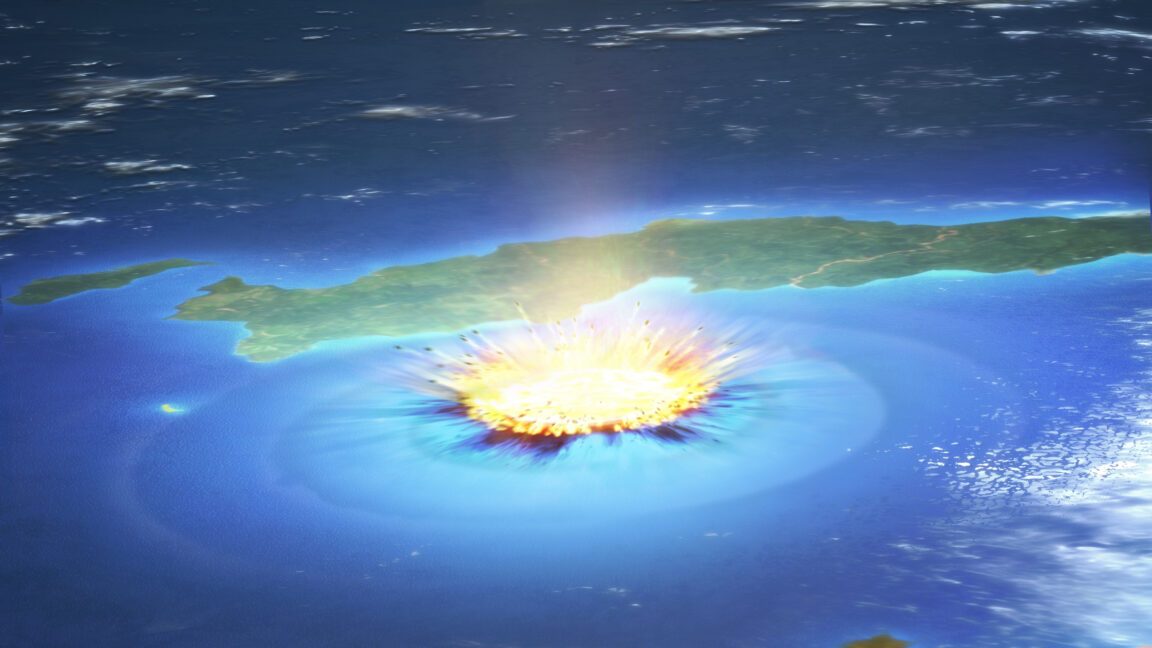
Approximately 66 million years ago, the Chicxulub asteroid struck Earth, triggering tsunamis and raining down hot debris that annihilated non-avian dinosaurs and many other species. However, not everything left in its wake was destructive. New research indicates that the hydrothermal system formed by this impact beneath the Yucatan Peninsula may have sustained conditions suitable for life for up to 8 million years, significantly longer than previously believed.
A research team led by geologist Annemarie Pickersgill from the University of Glasgow re-evaluated the scale and longevity of this system by studying rock samples from the crater. It was found that the system remained active for at least four times longer than the previously estimated 2 million years.
Highlights
- The Chicxulub asteroid impact created a hydrothermal system beneath the Yucatan Peninsula that lasted for up to 8 million years.
- This system may have remained active four times longer than the initially estimated 2 million years.
- Hot, nutrient-rich waters could have provided an extended window of opportunity for microbial life to thrive.
- Researchers determined the age of rock samples using potassium-argon dating methods.
- These findings suggest that larger impacts on Earth and other planetary bodies could create even longer-lived habitable environments.
Details
New analyses of rock samples collected from the impact zone in 2016 revealed that the collision caused deformation up to 35 km (almost 22 miles) beneath the surface, melting an immense amount of rock. Exposure to seawater made this molten rock porous, and as hot water seeped into these pores, a hydrothermal system formed. This gushing hot water in the freezing depths could have attracted microorganisms struggling to survive.
The research team utilized radioisotopic dating, measuring the decay of potassium into argon in feldspar rock samples. This method indicated that the hydrothermal system remained heated from 66 million years ago, when the asteroid first hit, until 58 million years ago. Computer simulations also suggested that cooling to 90°C (194°F) at depths of one kilometer took between 1.5 and 2.3 million years after the impact. Cooling to below 50°C (122°F) took up to 5 million years, still sufficient heat for microbial colonies to thrive. After 6 million years, significantly less hot water flowed, and by 8 million years, the flow had ceased.
Why it matters
This research demonstrates that large asteroid impacts might not only have destructive consequences but can also create long-lasting habitable environments. The discovery of this extended hydrothermal system in the Chicxulub crater supports the idea that similar, possibly even longer-lived, hydrothermal systems capable of sustaining life could have existed in larger impact basins on early Earth or other planetary bodies. This provides crucial insights for understanding the evolution of life and the search for extraterrestrial life on other planets.