Martian Cloud May Reveal Unprecedented Atmospheric Physics
A new study on a recurring Martian cloud suggests a unique ice-forming process, never before directly observed in any planetary atmosphere.
Highlights
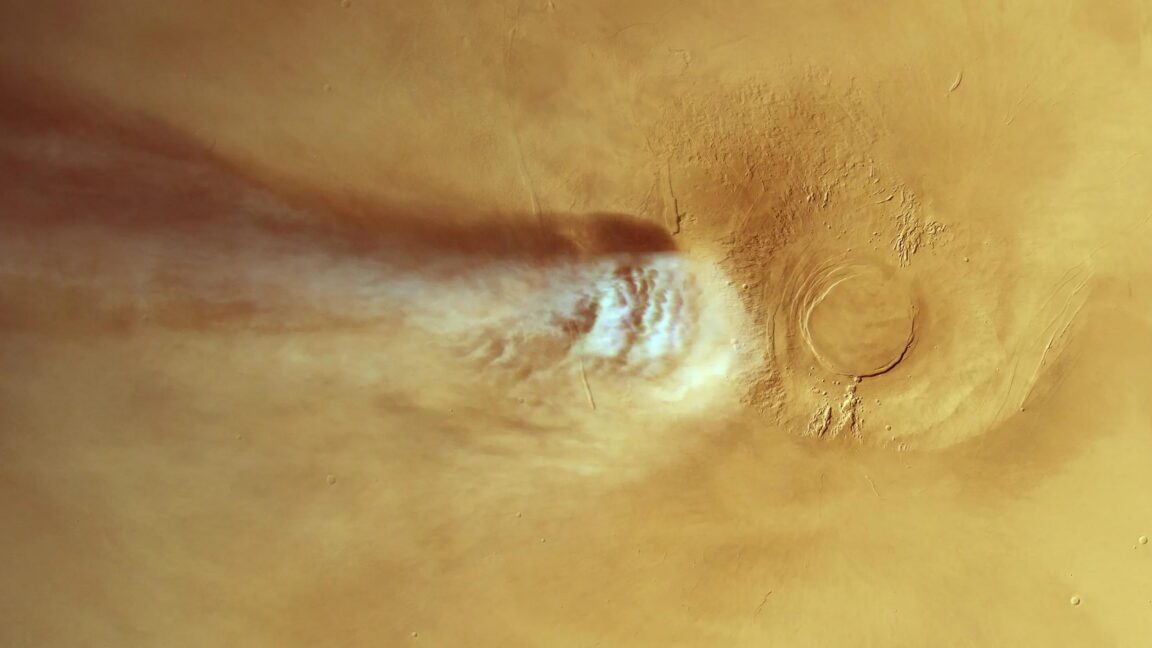
- A vast, elongated cloud, known as AMEC, forms daily near Mars' Arsia Mons volcano, stretching over 1,000 miles before dissipating.
- Researchers have successfully modeled this cloud's formation, attributing it to a process called homogeneous nucleation.
- This process involves water vapor transforming directly into ice crystals without the need for dust or other particles.
- The phenomenon requires extreme conditions: a rapid 30°C temperature drop within 10 minutes and exceptionally high humidity.
- The towering Arsia Mons volcano plays a crucial role by creating atmospheric waves that lift moist air to high altitudes.
Details
For years, the Arsia Mons Elongated Cloud (AMEC) has puzzled scientists. Each morning during the Martian spring and summer, this wispy formation emerges near the Arsia Mons volcano, gradually extending for hundreds of miles before vanishing again. This cycle repeats for several months, and its existence lacked a clear explanation until recently.
Planetary scientist Jorge Hernández-Bernal, a lead author from Paris's Sorbonne Université, explained that their new model necessitated the inclusion of what he termed “exotic physics.” This theoretical physics, while documented in textbooks, was not thought to occur naturally and had certainly not been observed in action. Unlike cloud formation on Earth, which typically involves water vapor condensing around particles like dust, the study, published in Nature Geoscience, proposes that AMEC forms through homogeneous nucleation. This is where vapor spontaneously converts into ice crystals without any external nuclei.
This unusual process demands specific, intense conditions: a sudden temperature decrease of 30°C within a mere ten minutes, coupled with extremely high relative humidity. The 65,000-foot-tall Arsia Mons volcano is integral to this, as wind currents striking its slopes generate powerful atmospheric waves. These waves propel moist air rapidly into the upper atmosphere, creating the precise environment required for homogeneous nucleation to occur.
Why it matters
While scientists have theorized that similar atmospheric phenomena could exist in the upper layers of planets such as Venus and Earth, direct observation has remained elusive. The discovery of these specific humidity levels on Mars, previously unknown, and the successful modeling of AMEC's formation, not only deepens our understanding of the Martian atmosphere but also expands our broader knowledge of cloud formation and atmospheric processes across different celestial bodies. This represents a significant advancement in planetary science and space exploration.```