IceCube Neutrino Observatory Founder Wins Physics Nobel Prize
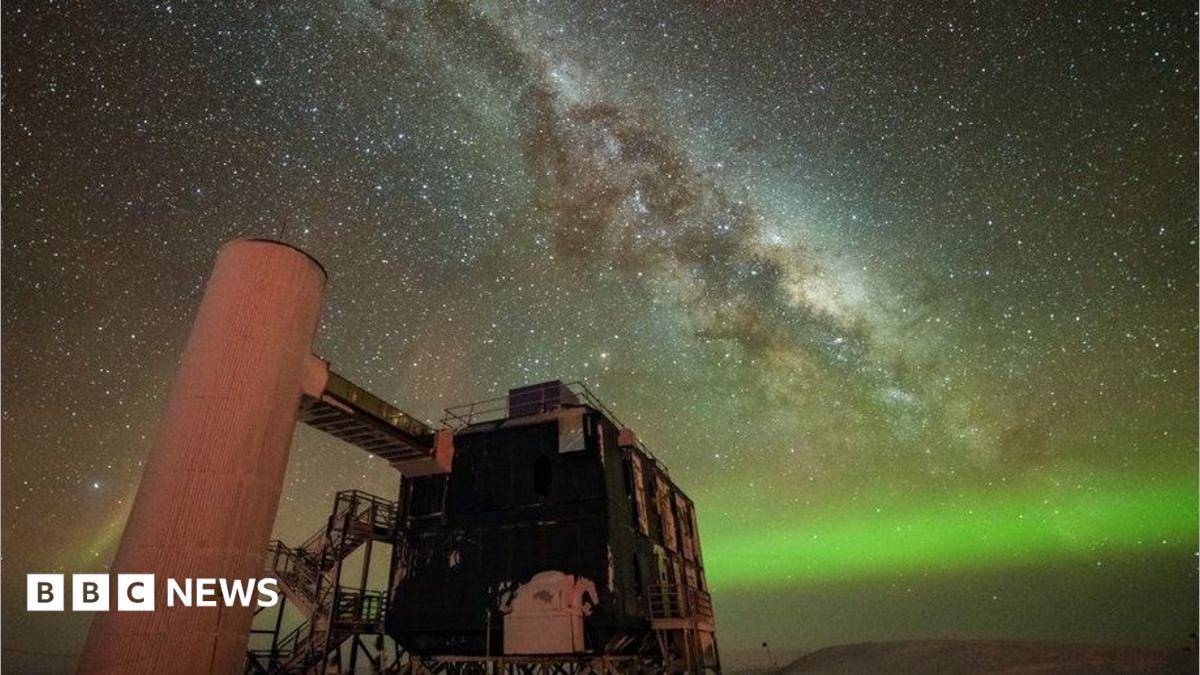
Belgian physicist Prof. Francis Halzen has been awarded the Nobel Prize in Physics for his decisive contributions to the development of the IceCube Neutrino Observatory. This groundbreaking observatory detects "ghost particles" from space, shedding light on the distant universe by capturing elusive neutrinos in Antarctic ice.
Highlights
- Prof. Francis Halzen received the Nobel Prize in Physics for his pivotal role in establishing the IceCube Neutrino Observatory.
- The observatory utilizes a cubic kilometer of Antarctic ice at the South Pole to detect high-energy neutrinos.
- Neutrinos are elusive subatomic particles that carry information about violent, high-energy processes in the cosmos.
- The Royal Swedish Academy of Sciences highlighted Halzen's vision and scientific leadership as fundamental to IceCube's success.
Details
Prof. Halzen led the development of IceCube, an observatory that uses light sensors embedded in Antarctic ice to detect particles called neutrinos. While the Sun produces billions of neutrinos every second, IceCube specifically searches for much higher-energy neutrinos, which are generated by violent processes in distant galaxies far beyond our Solar System. These neutrinos act as astronomical messengers, pointing to fundamental events in the universe.
Most neutrinos pass straight through the ice, but occasionally one interacts, producing particles that emit a telltale flash of light. These rare signals provide clues about the neutrinos' origins and the extreme conditions that created them, enabling scientists to investigate areas that ordinary telescopes cannot easily observe. Halzen admitted that even he was initially skeptical about the project's success, stating, "very few thought it would work, including myself."
Why it matters
The IceCube Neutrino Observatory has opened up a new era of astronomy, transforming our understanding of the universe. By studying cosmic events that are invisible to traditional telescopes, it provides invaluable insights into the most mysterious and energetic processes in the cosmos. This work represents a significant advancement in astrophysics and underscores the profound impact of Halzen's scientific vision on the global scientific community.